Structural Drying in Beaverton, OR
Surface dry is not dry. The drying team measures moisture inside framing, subfloor and wall cavities and keeps the equipment running until the readings say the structure is dry.
(888) 373-8814Speak with 24/7 Beaverton dispatch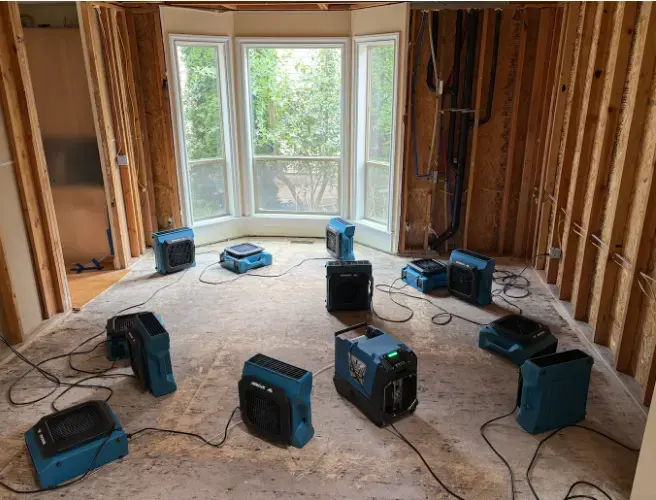
What to do the moment you find wet framing
- Stop the water
No drying plan works while water is still coming in.
- Pull wet rugs and pad
Soaked pad holds water against the subfloor.
- Do not seal it up
Hold off on paint, new flooring or baseboards until readings say dry.
- Call for readings
Meters and thermal imaging show what is still wet inside.
The trade facts
How wet framing is handled in Beaverton
The order of the work is what separates a finished dry-out from a cosmetic one.
- 1
Walkthrough and moisture map
The tech who does the walkthrough maps moisture with pinless meters and thermal imaging before any equipment goes down.
- 2
Extraction
The extraction crew pulls standing water with truck-mounted extraction, so the water leaves the building instead of moving to the next room.
- 3
Air movers and LGR dehumidifiers
The drying team sets air movers to each room's evaporation load and runs LGR dehumidifiers, or desiccants for Class 4 materials.
- 4
Daily readings to the drying goal
Most crews log readings daily and pull equipment once wet material sits within 2 to 4 points of a dry reference material.
Rapid local response
The response team answers around the clock and treats active water as an emergency, because every hour of wicking adds drying time.
IICRC S500 drying standard
IICRC S500 is the industry drying standard. Crews map moisture first and pull equipment only when the readings say dry.
Claim-ready documentation
Daily moisture readings, a moisture map and timestamped photos before any demolition: the file an adjuster reads.
Tualatin Valley water experts
Crawlspaces, clay soil, creek flooding and eight wet months: the local pros know how water moves in a Beaverton house.
What does structural drying and dehumidification cost in Beaverton, OR?
In Beaverton, OR, structural drying typically runs $1,200 to $8,000 or more. The drivers are the class of the loss, the square footage, the materials (hardwood, plaster and crawlspace framing take longest), and how fast drying started.
Class 1 or 2, one area
- Moisture mapping
- Air movers and LGR
- Daily logs
Multi-room or crawlspace
- More equipment
- Cavity drying
- Extended monitoring
Class 4 dense materials
- Desiccant dehumidifiers
- Hardwood and plaster
- Full documentation
These are typical ranges, not a quote. Get a closer planning number with the water damage cost calculator; the restoration contractor who responds scopes the real job on site.
Structural drying is the phase that decides whether a water loss is finished or just hidden. Drywall can feel dry while the stud behind it and the subfloor under the carpet still hold water. In Beaverton's damp winter air, that trapped moisture does not leave on its own, so the drying has to be measured and managed.
How the drying team decides what is dry
The tech who does the walkthrough takes readings in an unaffected part of the same building to set a dry reference for each material. The drying goal is wet material within 2 to 4 points of that reference. The drying team logs readings daily along with temperature and humidity, the psychrometric record the claim file uses.
The equipment and how it is set
- Air movers sized to each room's evaporation load and aimed along wet walls
- LGR (low grain refrigerant) dehumidifiers that pull water out of the air even in cool, damp conditions
- Desiccant dehumidifiers for Class 4 materials such as hardwood, plaster and dense framing
- Cavity drying for walls and cabinets, plus HEPA air scrubbers on contaminated losses
Class 1 through 4 sets how much equipment a room needs. A Class 1 loss touches a small area of low-porosity material; Class 4 involves dense materials that hold water tightly and need longer, more specialized drying. Drying usually follows water extraction.
Walls or floors still damp days after a leak? Call and have the moisture measured.
Call (888) 373-8814 for the Beaverton lineWhy it matters in a Beaverton winter
Outdoor air in the wet season is often near saturation, so opening windows does not help much, and closed drying with dehumidifiers is usually faster. The EPA guide to moisture in the home explains why wet materials need to dry within 24 to 48 hours, and OSU Extension covers moisture in Northwest homes.
Equipment leaves on readings, not on a schedule
A dry-out does not end after a fixed number of days. The drying team pulls equipment when the numbers reach the goal, and the log shows it.
Structural Drying and Dehumidification across Beaverton
The Beaverton water damage pros take calls from every Beaverton ZIP and the neighboring Washington County towns, day or night.
Coverage runs across Beaverton, Aloha, Cedar Mill, Bethany, Tigard, Hillsboro, Tualatin and the west side of Portland, ZIP codes 97003, 97005, 97006, 97007, 97008 and the Beaverton PO box ZIPs.
The restoration team asks for the cross street and which level of the house is wet, because that decides what goes on the truck.
See every neighborhood and ZIP coveredStructural Drying and Dehumidification questions
What is structural drying?
Structural drying removes moisture from the building itself: framing, subfloor, wall cavities and dense materials, not just the surfaces you can see. It is measured with meters against a dry reference.
Why not just open the windows?
In Beaverton's wet season, outdoor air is often as damp as the air inside. Closed drying with dehumidifiers pulls water out of the air faster than fresh air can.
How many air movers does a room need?
It depends on the class of the loss, the wet wall and floor area, and the room's evaporation load. The IICRC S500 standard gives the method crews use to size it.
What is the difference between LGR and desiccant dehumidifiers?
LGR units cool the air to condense water and work well in most conditions. Desiccant units use a drying wheel and handle cold spaces and dense Class 4 materials like hardwood.
How long does structural drying take?
A contained Class 1 loss usually dries in three to five days. Hardwood, plaster and crawlspace framing take longer.
Why do I need daily readings?
Daily readings show the drying is working and record when the goal was reached. Adjusters rely on that log when they review a claim.
Related water damage services in Beaverton
Structural Drying and Dehumidification in Beaverton? Call now.
Wet material keeps wicking until someone dries it. The Beaverton water damage pros answer day or night and start with extraction and a moisture map.